
You’ve spent hours sanding. You’ve mastered the perfect, buttery-smooth paint finish. You’ve even staged the piece with the perfect succulent and a vintage book. But then, you take a shortcut. You put back those dated, tarnished handles or: even worse: you buy the cheapest, flimsiest knobs from the discount bin.
Suddenly, your “boutique” flip looks like a yard sale leftover.
In the world of furniture flipping for beginners, hardware is often treated as an afterthought. In reality, hardware is the “jewelry” of your furniture. It is the final touch that tells a buyer if a piece is worth $100 or $500. If you are serious about your furniture flipping profit, you need to stop viewing knobs as a utility and start viewing them as a strategic investment.
Welcome to the Hardware Swap Masterclass. Let’s fix your margins.
The Invisible Profit Leak: Markup vs. Margin
Most flippers look at a set of knobs and think, “These cost me $20, so I’ll just add $20 to the price of the dresser.”
Stop right there. You just lost money.
When you are learning how to upcycle furniture, you have to understand the math of the “fully loaded” cost. If you spend $20 on hardware, you aren’t just out $20. You spent time sourcing those knobs. You spent gas going to the store or shipping costs getting them to your door. You spent 30 minutes measuring, leveling, and screwing them in.
The Math That Matters
Let’s look at the “Hidden Economics of a Knob” research.
- Markup: Adding a percentage to your cost. (If a knob costs $4 and you sell it for $6, that’s a 50% markup).
- Margin: The percentage of the selling price that is profit. (That same $6 sale only nets you a 33% margin).
If your business goal is a 50% margin to cover your paint, sandpaper, and: most importantly: your time, that $4 knob needs to be priced much higher in the final sale. If you don’t account for this, your hardware is quietly bleeding your bank account dry.

1. Style Selection: Matching the Era and the Vibe
The wrong style of hardware creates “visual friction.” This is when a buyer looks at a piece and feels like something is “off,” even if they can’t put their finger on it. Visual friction kills sales.
Mid-Century Modern (MCM)
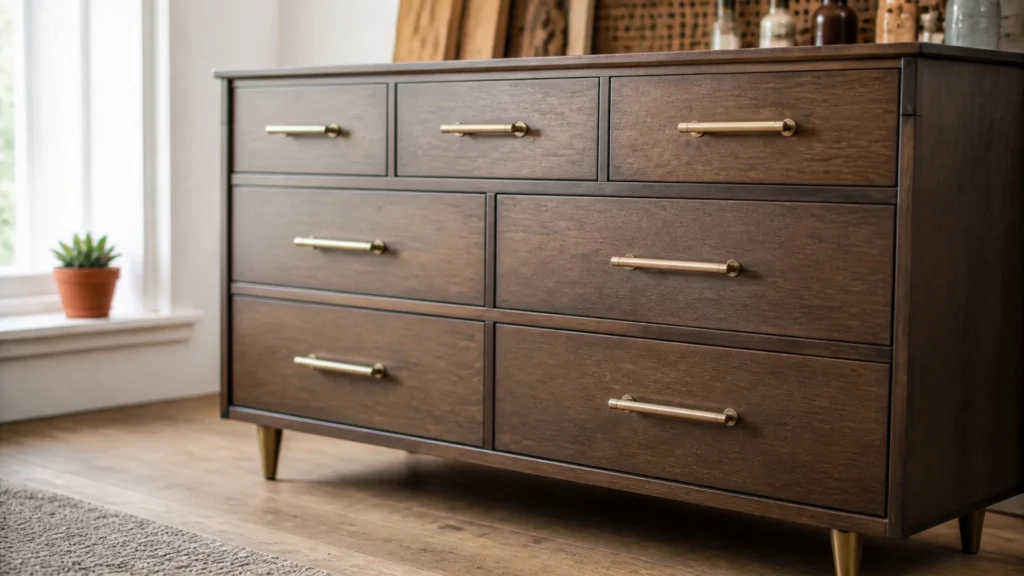
If you are flipping a sleek, tapered-leg dresser, do not put ornate, floral ceramic knobs on it. You need clean lines. Think thin bar pulls in matte black or brushed gold. MCM buyers want “minimalist luxury.”
Farmhouse and Rustic
For that chunky, distressed buffet, go for cup pulls or “bin pulls.” Finishes like oil-rubbed bronze or weathered iron work best here. These pieces should feel heavy and grounded.
Glam and Chic
If you’ve painted a vanity in a high-gloss pink or deep emerald, this is your time to shine. Lucite (acrylic) handles with gold accents or crystal-style knobs can elevate the piece instantly.
Pro Tip: Always look at the scale. Small knobs on a massive executive desk look ridiculous. Tiny pulls on a large drawer make the piece look “cheap.” When in doubt, go slightly larger than you think you need.
2. The Sourcing Blueprint: Quality Without the Price Tag
You cannot pay retail prices for hardware and expect to make a massive furniture flipping profit. If you go to a high-end hardware boutique and pay $15 per pull for a 10-drawer dresser, you’ve just spent $150 before you’ve even made a cent.
Here is how the pros source:
- Bulk Amazon and eBay Finds: You can often find packs of 10 or 20 matte black bar pulls for a fraction of the big-box store price. These are perfect for modern flips.
- Hobby Lobby’s Rotation: Hobby Lobby typically rotates a 50% off sale on their decorative hardware every other week. Never buy them at full price. This is the best place for unique, eclectic knobs.
- Thrift Store “Organ Donors”: Sometimes you can buy a beat-up $10 nightstand just because it has $40 worth of vintage brass hardware on it. Strip the hardware, toss the nightstand (or use it for parts), and you’ve won.
- The Spray Paint Trick: Don’t like the finish? If the shape is good, a can of high-quality metallic spray paint (like Rust-Oleum Metallic) can turn dated silver into trendy champagne bronze for pennies.

3. The Technical Masterclass: Installation Secrets
Nothing screams “amateur” like crooked handles. If your hardware is 1/16th of an inch off, the human eye will catch it, and the “value” of your piece will plummet.
The “Bondo” Method
Often, the hardware you want to use doesn’t match the holes already drilled in the furniture. Do not settle for “close enough.”
- Fill the old holes with Bondo Glass or a high-quality wood filler.
- Sand it flush until you can’t feel the seam.
- Prime and paint.
- Drill new holes that fit your dream hardware perfectly.
This allows you to move from dated 3-inch centers to modern, oversized pulls that actually fit the scale of the piece.
Use a Template
Stop measuring with a ruler every single time. Invest $10 in a plastic cabinet hardware jig. It ensures that every hole is perfectly centered and leveled. It turns an hour-long frustration into a five-minute breeze.

4. Finishes That Are Selling in 2026
If you want your diy home decor projects to move fast, you have to follow the trends. In 2026, we are seeing a shift away from the “all-white-everything” look toward more moody, sophisticated tones.
- Champagne Bronze: It’s warmer than gold but softer than brass. It looks expensive against navy, forest green, and charcoal grey.
- Matte Black: The “little black dress” of hardware. It works on almost everything and provides a sharp, modern contrast.
- Unlacquered Brass: For the high-end vintage look. It patinas over time, which high-end buyers absolutely love.
5. The “Good-Better-Best” Strategy
When you are planning your flip, categorize your hardware strategy based on your target exit price.
- The “Good” Strategy (Entry Level): Use bulk-bought standard pulls. Keep your hardware cost under $15 for the whole piece. Target fast-flip buyers on Facebook Marketplace.
- The “Better” Strategy (Mid-Range): Use trend-specific hardware (like matte black or brushed nickel) and maybe a slightly larger scale. Target buyers looking for “statement pieces” for their guest rooms.
- The “Best” Strategy (Boutique): This is for your high-ticket items. Use heavy, solid metal hardware or unique artisan knobs. If you spent $50 on the hardware, you should be aiming to increase your asking price by at least $150.
Your Hardware Profit Checklist
Before you list your next project in our project gallery, run through this quick checklist:
- Does the scale match? Ensure the hardware doesn’t look “lost” on the drawer fronts.
- Is the finish cohesive? Don’t mix silver hinges with gold knobs unless you are a pro at the “mixed metal” look.
- Are the holes filled? No ghost holes from the old hardware should be visible.
- Is it level? Use a jig. No excuses.
- Did you do the math? Ensure your final price reflects the hardware cost and the labor of installing it.
Conclusion
Hardware is not just a way to open a drawer; it is a signal to the buyer about the quality of the entire piece. When you choose the right knobs, you aren’t just finishing a project: you are justifying a higher price point.
Stop letting the wrong knobs kill your profit margin. Start treating your hardware like the strategic asset it is.
Ready to see what a difference the right hardware makes? Check out some of our recent transformations in the Before and After Gallery. If you have a specific piece that needs a hardware overhaul but you aren’t sure where to start, feel free to reach out for a project request.
Now, go grab a template and start drilling!