A low-priced piece of furniture is not always a good flipping opportunity.
Sometimes the ugly dresser at the thrift store is solid wood hiding under a tired finish. That is good news. Scratches, stains, and dated color can often become part of a successful transformation.
Other times, the “wood” cabinet has swollen edges, a damaged veneer, or a crumbling MDF core. That project can quickly turn into a money pit.
The difference comes down to one question:
Can the piece be repaired, refinished, and sold for more than you spend?
This guide will help you tell MDF, veneer, and solid wood apart before you buy. You will also learn which flaws are fixable, which ones are deal-breakers, and how to make a confident buy-or-walk-away decision.
Start With the Material, Not the Makeover
Before you imagine paint colors or new hardware, identify what the furniture is made from.
Solid wood
Solid wood is made from natural lumber throughout the main component. You may see:
- Natural grain variation
- End grain on exposed edges
- Slight color changes between boards
- Small knots or irregularities
- Traditional joinery on older or better-built pieces
Solid wood can usually be sanded, repaired, stained, painted, and refinished more than once.
That repairability makes it especially valuable for furniture flipping.
MDF
MDF, or medium-density fiberboard, is made from wood fibers and resin compressed into sheets.
It usually has:
- A very smooth, uniform surface
- No natural grain
- Dense, heavy panels
- Easily damaged corners
- A tan or gray fibrous core when chipped
MDF can be a perfectly practical material. It often creates a smooth surface for paint and is common in modern cabinets, bookcases, and flat-pack furniture.
The problem is moisture and deep damage.
Once MDF swells, puffs, or crumbles, it is difficult to restore. You can fill and paint minor damage, but you cannot simply sand a swollen panel back to its original shape.
Veneer over MDF or particleboard
Veneer is a thin layer of real wood attached to another material. The top may look like beautiful oak, walnut, or mahogany, while the core underneath is MDF or particleboard.
Veneer is not automatically a bad choice for flipping. It can work well when it is firmly attached and mostly intact.
The danger comes when you sand too aggressively or buy a piece with widespread lifting, bubbling, or missing veneer.

Learn How to Identify the Construction in Five Minutes
You do not need woodworking experience to inspect a piece. You just need to look where sellers often do not.
1. Check the underside
Look beneath the tabletop, shelf, or cabinet.
Solid wood may show:
- Plank lines
- Natural grain
- End grain
- Uneven but believable color variation
MDF will look smooth and consistent. Veneer may show a thin decorative layer over a different-looking core.
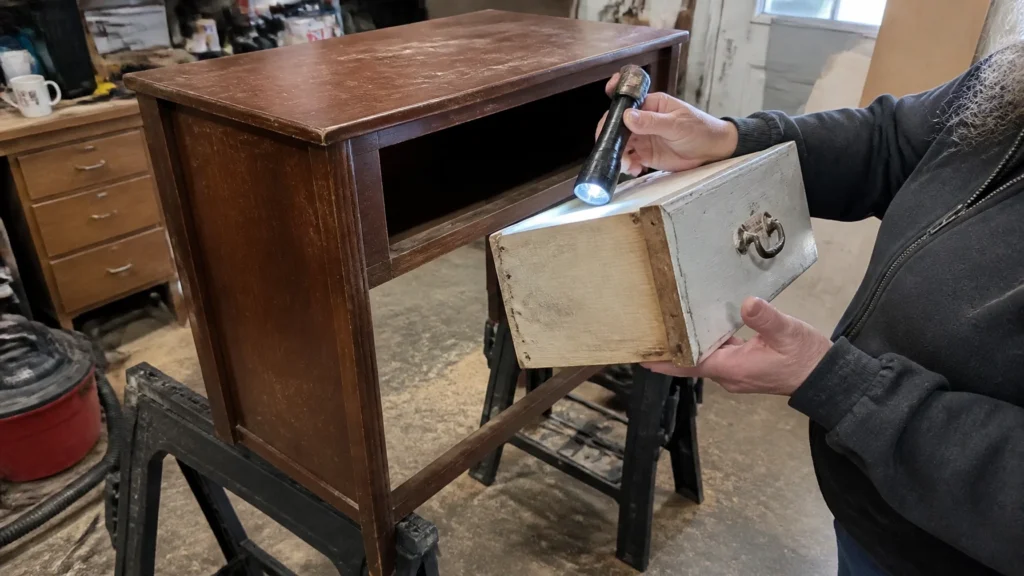
Use your phone flashlight if the lighting is poor. Do not rely on the front of the furniture alone.
2. Inspect the edges
Edges tell the truth.
Look at:
- Table corners
- Drawer fronts
- Shelf edges
- The bottom of side panels
- Areas around missing trim
If the grain wraps naturally around an edge, the piece may be solid wood. If the grain stops abruptly or appears to be a thin layer, it is likely veneer.
If you see compressed fibers, you are looking at MDF.
3. Open the drawers
Drawer construction can reveal a lot.
Check the drawer sides, bottom, and joints. Older solid-wood furniture may have dovetail joints, visible grain, or wood bottoms. MDF and particleboard drawers often have smooth, uniform surfaces and simpler construction.
This is not a perfect test. Furniture styles and manufacturers vary. Use it with the other clues.
4. Look for water damage
Pay close attention to the bottom edges and corners.
Warning signs include:
- Puffing
- Swelling
- Soft spots
- Crumbling fibers
- Bubbling laminate
- Dark water marks
- A panel that no longer sits flat
A small stain on solid wood may be repairable. A swollen MDF base is usually a walk-away problem.
5. Use weight as supporting evidence
MDF is often surprisingly heavy. That does not mean it is solid wood.
Some hardwoods are heavy, too. Weight can support your inspection, but it should never make the decision by itself.
Choose Solid Wood When You Want More Repair Options
Solid wood is usually the strongest choice for beginners because it gives you room to correct mistakes.
A scratched solid-wood dresser can often be:
- Cleaned thoroughly.
- Repaired with wood filler where needed.
- Sanded gradually.
- Stained or painted.
- Sealed for protection.
- Updated with fresh hardware.
Deep dents may steam out or sand down. Loose joints can often be tightened or reglued. Worn edges can be shaped, filled, or blended into the design.
That does not mean every solid-wood piece is worth buying. Severe warping, extensive woodworm damage, structural cracks, and missing parts can still destroy your budget.
But solid wood gives you more possible solutions.
For more guidance on building a simple project process, follow this five-step furniture upcycling framework.
Consider MDF Only When the Damage Is Cosmetic
MDF can still make a profitable flip. You just need to choose the right project.
Good MDF candidates include:
- Modern nightstands
- Painted bookcases
- TV units
- Small cabinets
- Simple shelving
- Pieces with intact laminate and clean lines
MDF is most suitable for a painted makeover. Avoid plans that require heavy sanding, deep stripping, or exposing a natural wood finish.
The best approach is gentle:
- Clean the surface thoroughly.
- Lightly scuff the finish.
- Repair small chips with suitable filler.
- Sand the repair smooth.
- Apply a high-adhesion primer when needed.
- Paint with thin, even coats.
- Protect high-use surfaces with an appropriate topcoat.
Do not sand MDF aggressively. Once you expose the core, the edge can become fuzzy and difficult to finish cleanly.
MDF also does not hold screws as reliably as solid wood, especially near damaged edges. Avoid pieces with loose hinges, stripped screw holes, or hardware that has pulled out of the board.

Walk Away From These Expensive Problems
Some flaws look small in a marketplace photo but become obvious once the piece is in your workspace.
Walk away, or negotiate very carefully, when you find:
Swollen MDF
Swollen MDF is one of the clearest red flags. Paint can hide discoloration, but it cannot restore the original shape or strength.
Widespread veneer lifting
A small loose patch may be repairable. Veneer lifting across an entire top or several panels is a different story.
You may spend more time re-gluing, clamping, filling, and disguising the damage than the finished piece is worth.
Crumbling corners
Corners take a lot of wear. If the core is crumbling, new paint will not solve the structural problem.
Severe odors or contamination
Smoke, mildew, pet odors, and unknown stains can be difficult to remove. Inspect the back, drawers, and enclosed areas before buying.
Missing structural parts
A missing knob is easy. A missing drawer, leg, back panel, or support rail may require custom work.
Poor resale potential
A repairable piece is not automatically profitable. Consider its size, style, local demand, and likely selling price before you load it into your car.
Use This Quick Buy-or-Walk-Away Scorecard
Before paying, answer these questions:
Buy with confidence
- Is the piece structurally sound?
- Are the joints firm or easy to repair?
- Is solid wood visible in the important areas?
- Is the veneer intact?
- Is MDF free from swelling?
- Can you complete the makeover with supplies you already own?
- Is the finished style likely to appeal to local buyers?
Proceed with caution
- Does the piece need extensive stripping?
- Are several edges chipped?
- Is the hardware missing?
- Is the surface laminate difficult to prime?
- Will transportation or storage be a problem?
- Are you guessing about the material instead of confirming it?
Walk away
- Is the MDF swollen or crumbling?
- Is the piece badly warped?
- Are key structural parts missing?
- Is there active mildew?
- Would the repairs take longer than the resale value justifies?
Calculate the Flip Before You Buy
Do not let a cheap purchase price trick you.
Write down:
- Purchase price
- Transportation cost
- Paint and primer
- Filler, sandpaper, and repair supplies
- New hardware
- Sealer
- Selling fees
- Your estimated labor
- Target selling price
Then subtract the total cost from the expected selling price.
A free piece can still be an expensive project if it needs $100 in supplies and ten hours of repair.
A $40 solid-wood dresser may be a better deal than a free MDF cabinet with water damage.
That is the difference between cheap furniture and cheap potential.

Match the Material to the Finish
The material should guide your makeover plan.
For solid wood
Try:
- Natural stain
- Clear protective finish
- Two-tone paint and wood
- Light distressing
- Deep color with visible grain
- Traditional or vintage-inspired refinishing
Solid wood is the better candidate when the grain is part of the finished look.
For MDF or veneer
Try:
- Solid paint colors
- Warm earth tones
- Simple modern styling
- New pulls or knobs
- Painted trim
- A clean, contemporary finish
Avoid promising a natural-wood transformation when the veneer is damaged or the MDF core is exposed.
If you need color direction, explore The 2026 furniture paint colors that are selling flips fast.
Remember: The Best Flip Is the One You Can Finish
Beginners often choose projects based on appearance.
Experienced flippers look underneath.
They check the material. They test the joints. They inspect the edges. They calculate the costs. They decide before emotion takes over.
Solid wood is usually the more forgiving option. It offers better repairability and more finishing choices.
MDF can still be worth flipping when it is dry, stable, intact, and suited to a painted makeover.
The goal is not to find furniture with no flaws. The goal is to find flaws you can fix without losing your time, money, or confidence.
For more real-project inspiration, visit The Crafty Renewal before-and-after gallery.
Your Simple Furniture-Flipping Rule
Use this rule on your next sourcing trip:
Buy solid wood with ugly surfaces. Buy MDF only with stable surfaces. Walk away from swollen, crumbling, or structurally damaged pieces.
That one decision can prevent hours of frustration.
Start small. Inspect carefully. Track your costs. Choose projects that match your skill level.
The transformation from worn and questionable to fabulous and sellable starts before the first coat of paint.