
We’ve all been there. You’re driving down a side street, and there it is: a mid-century modern dresser sitting on the curb with a “FREE” sign taped to the front. Your heart starts racing. You see the vision. You see the sleek black hardware, the moody forest green paint, and the hefty profit landing in your Venmo account.
But then you get it home. You realize the drawers are swollen shut, the bottom is rotting, and it smells like a pack of cigarettes lived inside it since 1974. Suddenly, that “free” find is costing you hours of frustration and a corner of your garage that you’ll never get back.
Furniture flipping for beginners is an incredible side hustle, but the secret to success isn’t just knowing how to upcycle furniture, it’s knowing when to say “no.” To build a profitable business and avoid the dreaded flipper’s burnout, you need a system.
Here is your “Is It Worth It?” checklist. If a piece hits any of these five red flags, walk away.
1. The Smell of “No Return”
Trust your nose. It is the most honest tool in your kit. While you can fix a scratch or replace a knob, smells are a different beast entirely.
If you open a drawer and are hit with the overwhelming scent of heavy cigarette smoke, moldy mildew, or, the worst, cat urine, do not put that piece in your car. Odors penetrate deep into the fibers of the wood. You can scrub with vinegar, seal it with shellac, and bake it in the sun for a week, but often, the moment a buyer gets that piece into a warm, humid house, the smell returns.
The Reality Check:
- Mildew: Usually means there is internal rot or mold you can’t see.
- Smoke: Requires multiple coats of expensive primer and hours of cleaning.
- Pet Stains: These often soak into the wood and will bleed through your fresh paint later.
If the piece smells like a basement that hasn’t been opened since the Cold War, let it go. You’re better off spending your time on a clean piece like a white wooden storage box that just needs a little cosmetic love.
2. Structural “Deal-Breakers”2. Structural “Deal-Breakers” (The Sag and the Snap)
When you’re learning how to upcycle furniture, you’ll naturally pick up some carpentry skills. But there is a massive difference between tightening a screw and rebuilding a skeleton.
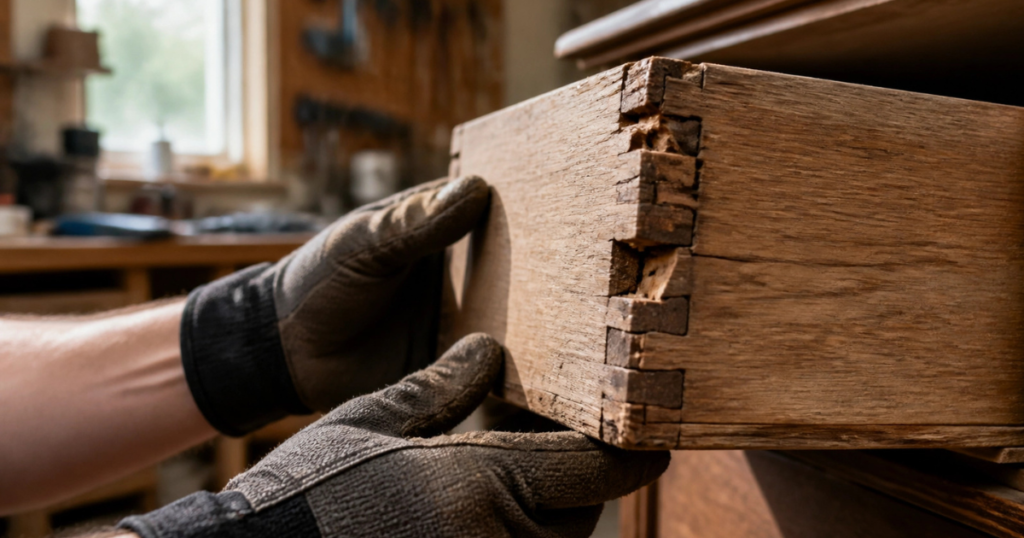
Before you buy, check the “bones.” Is the frame solid wood, or is it particle board? Particle board (that compressed sawdust material) is a nightmare to flip. If it gets wet, it swells like a sponge and loses all structural integrity. You can’t sand it, and it doesn’t take paint well.
Look for these structural red flags:
- Extreme Sagging: If the middle of a dresser or bookshelf is dipping significantly, the internal supports are shot. Fixing this usually requires taking the whole piece apart.
- Broken Joinery: If the legs are wobbly because the wood has actually snapped at the joint, it’s a high-level repair.
- Swollen Drawers: If the drawers don’t slide and the wood is warped, you’ll spend days planing and sanding just to get them to close.
3. The Math Doesn’t Survive the “Reality Check”
Furniture flipping for beginners is a business, not just a hobby. If you want this to be a profitable side hustle, you have to run the numbers before you hand over your cash.
A “cheap” $20 nightstand can quickly become a $100 investment once you factor in:
- Transport: Gas and time spent driving to pick it up.
- Supplies: Sandpaper, high-quality primer, boutique paint, and topcoat.
- Hardware: Modern knobs can cost $5 to $10 each. A 6-drawer dresser might need $60 in hardware alone!
- Repairs: Wood filler, glue, or replacement drawer slides.
The Blueprint for Profit:
Take the estimated resale price (look at what similar items are selling for in your local Facebook Marketplace) and subtract your costs. If you’re left with a $40 profit but it’s going to take you 10 hours to finish, you’re making $4 an hour.
Is your time worth more than $4 an hour? Of course it is. Sometimes it’s better to invest in smaller, high-margin items like a decorative round serving tray or a small collection storage box that requires less labor but offers a quick flip.
4. The Time-Suck Factor (The Burnout Zone)
Burnout is the number one reason people quit furniture flipping. It usually happens because you took on a piece that was too complex for your current skill level or schedule.
Some pieces are “time vampires.” For example, a piece with ten layers of old, chipping lead paint will require days of tedious, safe stripping. Or a chair with intricate, hand-carved spindles that need to be hand-sanded in every tiny crevice.
Ask yourself these questions before committing:
- Do I have the tools to do this efficiently?
- Will this project take up my entire garage for a month?
- Am I excited about this, or do I already dread starting it?
If you feel overwhelmed just looking at the piece at the thrift store, walk away. Flipping should feel empowering, not like a chore. Keep your momentum high by choosing pieces that offer a “quick win.” A simple distressed white side table project can give you the boost you need to keep going.
5. The “Oddball” Piece That Won’t Sell
You might love a three-legged corner desk with a built-in fish tank, but will anyone else? One of the biggest mistakes beginners make is buying pieces that are too “niche.”
To make money in this side hustle, you need to cater to what buyers actually want. In 2026, buyers are looking for functional, classic pieces that fit modern home aesthetics, think Farmhouse, Modern Organic, or Scandi-style.
Avoid these marketability traps:
- Awkward Sizes: Massive armoires that don’t fit in modern apartments.
- Bizarre Layouts: Desks with tiny leg holes or cabinets with unusable shelving heights.
- Overly Specific Styles: Unless you have a specific client in mind, stick to pieces that have broad appeal, like an olive green end table or a barn red farmhouse entryway table.
The Psychology of Saying “No”
Walking away from a piece feels like losing a deal, but it’s actually a win for your business. Every “no” you say to a bad piece is a “yes” to a better project that will actually make you money.
When you leave a bad flip behind, you are:
- Saving Your Space: Your workspace stays clear for profitable items.
- Saving Your Sanity: You avoid the frustration of a project that won’t go right.
- Protecting Your Brand: You only put out high-quality work that you’re proud to sell.
Start Small and Scale Up
If you’re just starting your furniture flipping side hustle, don’t feel like you have to jump into a full dining room set. Start with smaller home décor items. They allow you to practice your painting and distressing techniques without the risk of a major financial loss.
Check out items like the rustic chicken wire basket or a small cream curio shelf. These are perfect for practicing your “eye” for design.
Final Thoughts
The next time you see a piece of furniture on the curb or at the thrift store, pull out this checklist. If it smells okay, the bones are solid, the math works, the time is manageable, and the style is marketable: grab it!
But if it fails even one of these tests, keep driving. Your future self (and your bank account) will thank you. Ready to find some inspiration for your next project? Head over to The Crafty Renewal Shop to see how we turn simple pieces into farmhouse treasures.
Get out there, stay practical, and happy flipping!