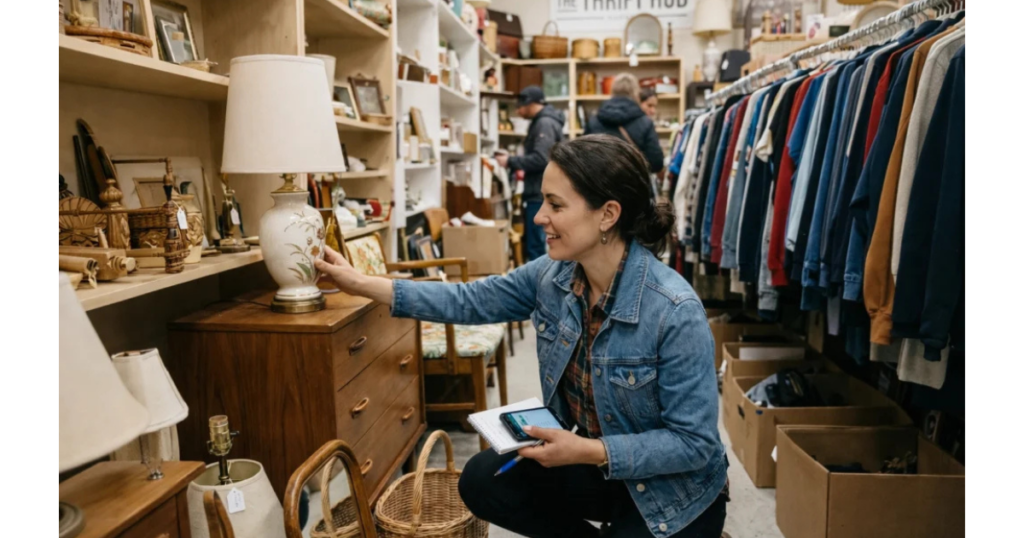
We’ve all been there. You walk into a thrift store with high hopes and a coffee in hand, ready to find that one diamond in the rough. Two hours later, you walk out with dusty fingers, a sore back, and absolutely nothing to show for it.
Thrifting for profit: or even just for your own home: shouldn’t feel like a chore. If you want to turn your hobby into a hustle, you need to stop “browsing” and start “hunting.” Time is your most valuable asset when you’re into furniture upcycling. Every minute you spend staring at a broken particle-board dresser is a minute you aren’t finding a mid-century modern masterpiece.
I’ve spent years navigating the aisles of Goodwill, Salvation Army, and local mom-and-pop shops. Over time, I’ve developed a “sixth sense” for what sells, but it’s not magic: it’s a system. Here are my 7 quick hacks to help you stop wasting time and start finding flips that actually put money in your pocket.
1. The “Knuckle Test” for Material Quality
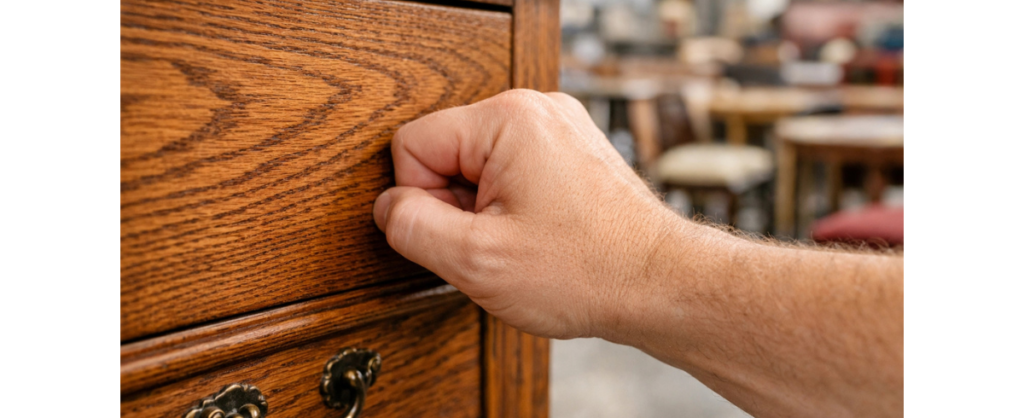
The biggest time-waster is falling in love with a piece of furniture only to realize it’s made of cheap, pressed sawdust (MDF) once you try to sand it. Before you even look at the price tag, give the piece a firm rap with your knuckles.
- The Thud: A deep, solid “thud” usually indicates solid wood or high-quality plywood. This is your green light.
- The Echo: A hollow, sharp “clack” usually means thin laminate or particle board.
Why does this matter? Particle board doesn’t take stain well, it swells when it gets wet, and it has almost zero resale value compared to real wood. Save your energy for the before and after projects that people actually want to buy.
2. Decode the Dovetail
If you want to find furniture that was built to last (and sells for a premium), look at the drawers. Pull a drawer out and look at the side where the front meets the side panel.
- Dovetail Joints: These look like interlocking teeth. They are a hallmark of quality craftsmanship. Even “machine-cut” dovetails from the mid-20th century signify a piece that is worth your time.
- Staples or Glue: If the drawer is just stapled together, walk away. It’s a “dud” that will likely fall apart before you even get it home.
Finding a piece with dovetail joints is an immediate indicator that the furniture has “good bones.” These are the pieces that anchor a room and fit perfectly into home styling and décor trends.
3. Shop the “Rich” Zip Codes
It’s a simple truth of thrifting: the quality of the donations depends on the neighborhood. If you want high-end brands like Pottery Barn, West Elm, or vintage Ethan Allen, you need to go where those items are originally purchased.
Schedule your “thrift runs” in affluent areas. People in these neighborhoods are more likely to donate high-quality furniture simply because they are redecorating, not because the item is broken. You’ll spend less time digging through junk and more time picking between high-value items. It might be a longer drive, but the “profit per hour” makes it worth every mile.
4. Master the “Google Lens” Hack
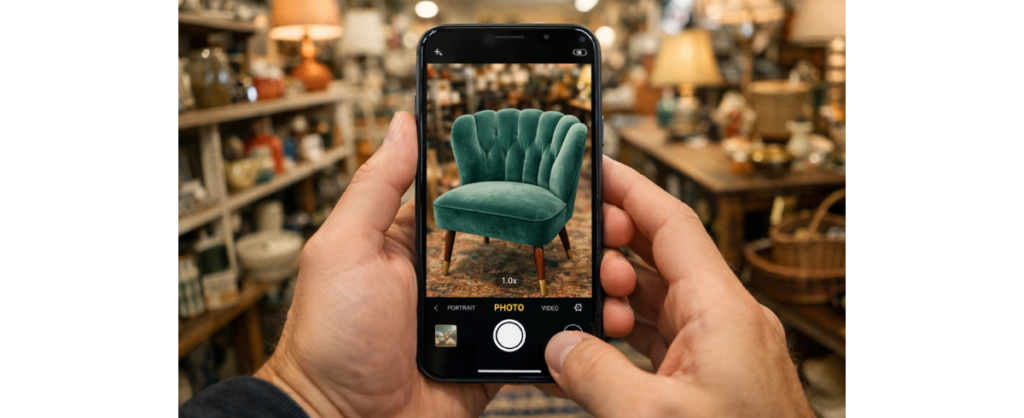
Stop guessing what something is worth. If you find a unique chair or a cool vintage lamp but aren’t sure of the brand, pull out your phone.
Open the Google app and tap the camera icon (Google Lens). Snap a photo of the item. Within seconds, Google will show you similar items for sale across the web.
- Check the “Sold” Listings: If you see the item on eBay or 1stDibs, don’t look at the asking price: look at what people are actually paying.
- Identify Designers: This is the fastest way to spot a designer “dupe” or a genuine mid-century modern icon that the thrift store priced at $10 because they didn’t recognize the shape.
5. Follow the Magnet Rule for Hardware
Hardware can make or break a flip. Replacing all the handles on a dresser can cost $50 to $100, which eats your profit alive. Before you buy a piece with “gold” hardware, carry a small magnet in your pocket.
- The Magnet Sticks: It’s cheap plated steel. It might look okay, but it’s not high-value.
- The Magnet Doesn’t Stick: It’s likely solid brass. Solid brass hardware can be cleaned up to a stunning shine and is a massive selling point for buyers looking for quality.
Even if you hate the furniture piece, sometimes the hardware alone is worth the price of the item. I’ve bought $5 nightstands just to harvest $40 worth of vintage brass pulls for other projects.
6. The “Second Lap” Strategy
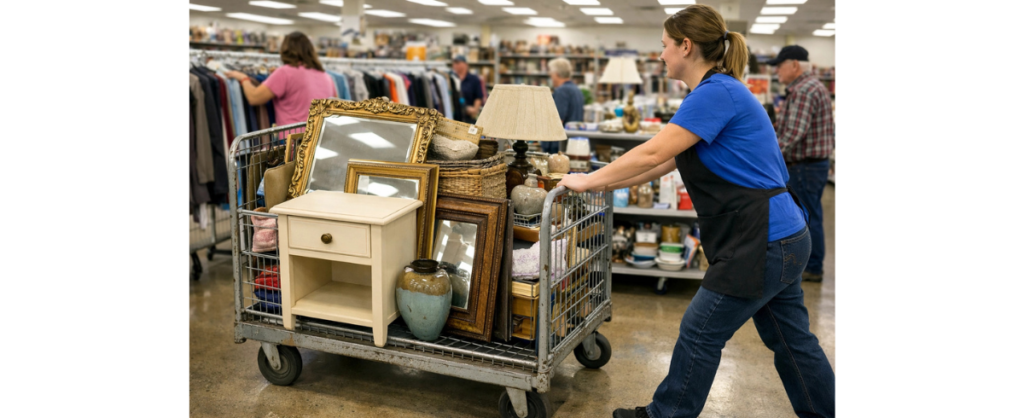
Most people walk through a thrift store once and leave. Professional flippers know about the “restock roll-out.” Thrift store employees are constantly bringing out new carts from the back.
- The Strategy: Do your first quick scan of the furniture section. Then, go look at the home décor or “smalls” for 15 minutes. Before you head to the register, do a second lap of the furniture area.
- The Result: You’d be shocked at how often a “holy grail” piece is wheeled out while you were looking at coffee mugs. By being there for that second pass, you beat the crowd to the best fresh inventory.
7. Know the Tag Cycles
Most major thrift stores use a color-coded tag system. Every week, a specific color goes on sale (often 50% off).
- Ask the Staff: Ask a worker, “What color is 50% off today?” and “When do you put out the new color?”
- Target the “New” Color: While 50% off is great for personal projects, the best items usually sell the day they hit the floor. If you know that “Blue” tags are the newest arrivals, focus your energy on the blue-tagged items. They haven’t been picked over yet.
Avoiding the “Duds”: A Quick Checklist
To stay profitable and efficient, you must be ruthless. If a piece hits any of these “red flags,” it’s probably a waste of time:
- Smell: If it smells like heavy smoke or “pet accidents,” leave it. Those smells are incredibly hard to remove from wood and will kill a sale.
- Major Structural Damage: A loose leg is an easy fix. A warped tabletop or a cracked frame is a nightmare.
- Missing Drawers: Unless you plan to turn it into a bookshelf, a missing drawer makes a dresser almost worthless.
Your Flipping Blueprint
Thrifting is a volume game. The more stores you hit with a focused plan, the more money you make. Don’t get distracted by the “cute” stuff that requires 20 hours of repair. Look for the solid wood, the designer shapes, and the clean lines.
Start using these hacks on your next run. Track your time and see how much faster you find your next project. You’ll find that when you stop wasting time on the junk, you have more energy to create something truly fabulous.
Ready to get started? Grab your magnet, charge your phone, and head to the “good” part of town. Your next big flip is waiting behind those sliding glass doors. Happy hunting!