
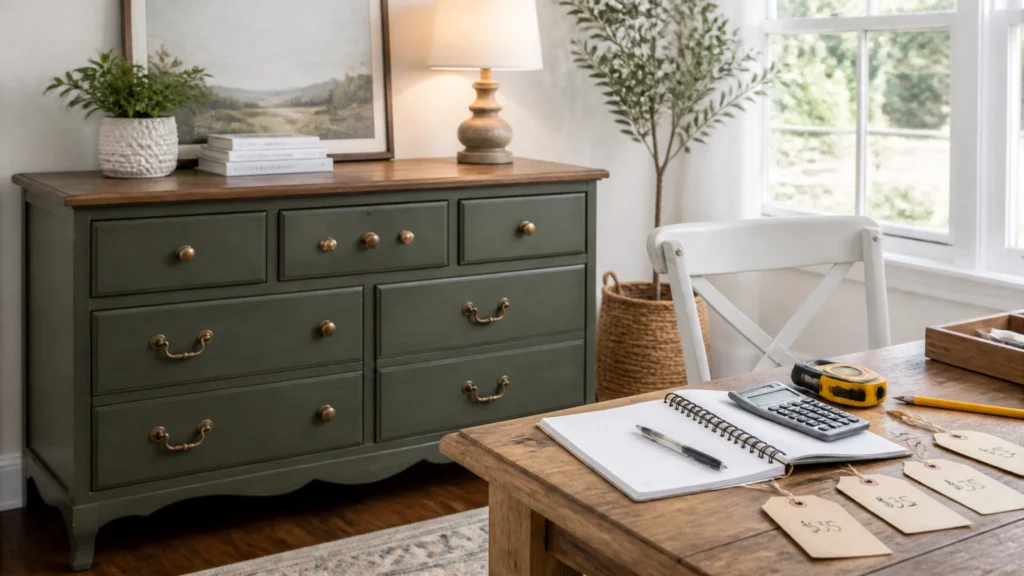
You’ve found the perfect piece, spent hours painting it, and finally sold it. But when you look at your bank account, the “profit” feels more like a hobby than a side hustle. Sound familiar?
Furniture flipping for beginners is an exciting journey, but it’s easy to get stuck in a cycle where you’re working hard for very little return. If your furniture flipping profit has plateaued, you aren’t alone. Most flippers make the same handful of mistakes that eat away at their margins.
The good news? These are all fixable. By shifting your approach from “crafting” to “business,” you can turn those meager gains into a serious income stream. Here are 10 reasons your profit isn’t growing and the practical steps to fix them today.
1. You’re Overpaying for Your Raw Pieces
Profit is made when you buy, not just when you sell. If you’re spending $100 on a dresser that needs $50 in supplies and only sells for $250, your margin is already too thin.
The Fix: Start hunting in the “free” sections of Facebook Marketplace or hit garage sales on Sunday afternoons when sellers are desperate to clear out. Aim to spend no more than 20-30% of your projected selling price on the raw piece. If you want more tips on finding the right deals, check out our Beginner Furniture Flip System.
2. You Haven’t Mastered “The Bones”
Not every piece of furniture is worth your time. If you’re buying particle board or pieces with massive structural damage, you’re setting yourself up for a low-value flip that takes twice as long to fix.
The Fix: Focus on solid wood. Learn to identify “good bones”: clean lines, sturdy joints, and classic shapes that never go out of style. Avoid heavy upholstery projects early on, as the cost of fabric and time can kill your furniture flipping side hustle before it starts.

3. Your Labor “Cost” is Invisible
The biggest mistake beginners make is ignoring their time. If a flip makes $100 profit but took you 20 hours, you’re earning $5 an hour. That’s not a business; that’s a very expensive hobby.
The Fix: Track your hours. Every minute spent sanding, painting, and staging counts. Use our Profit Planner to log your time and ensure your hourly rate is actually worth the effort. If a project is taking too long, simplify your design.
4. Skipping the Prep Work
It’s tempting to dive straight into the “fun” part (painting), but skipping cleaning and scuff-sanding is a profit-killer. Why? Because when the paint peels a week later, you’ll have to refund the customer or redo the entire piece for free.
The Fix: Get a dedicated prep kit. Clean with a degreaser, scuff-sand the surface, and use a primer if you’re working with “bleeders” (like mahogany or cherry). A durable finish means happy customers and zero costly redos.
5. Overspending on High-End Supplies
You don’t need the most expensive boutique paint for every single project. Using a $40 quart of paint on a $50 side table is a quick way to lose money.
The Fix: Learn which brands offer the best value. Our Paint Brand Guide breaks down the best affordable options that still deliver a professional look. Use high-end products for high-end pieces, and reliable, budget-friendly options for your bread-and-butter flips.

6. Your Photos Don’t Tell a Story
People don’t buy furniture; they buy how that furniture will make their home feel. If your photos are dark, cluttered, or taken in a messy garage, buyers will low-ball you every time.
The Fix: Stage your pieces. Move the furniture to a spot with natural light, add a simple lamp or a stack of books, and use a clean background. Great photography can easily add $50-$100 to your selling price.
7. Weak Descriptions on Marketplaces
“Blue dresser for sale, $200” isn’t a listing: it’s a missed opportunity. If you aren’t using keywords or describing the quality, your piece will get buried in the search results.
The Fix: Use a directive, benefit-driven description. Mention that it’s “Solid Wood,” “Hand-Painted,” and “Perfect for a Nursery.” Include the dimensions clearly. Good copy builds trust and justifies a higher price point.
8. Pricing Based on Emotion, Not Data
Many flippers price their pieces based on how much they love them or how hard they worked. The market doesn’t care about your feelings; it cares about what similar pieces are selling for in your zip code.
The Fix: Do your research. Check “Sold” listings on local marketplaces to see the actual “going rate.” If you’re struggling with the math, our furniture flipping guide resources can help you find that “sweet spot” where the piece moves fast but the profit stays high.
9. Lack of a Consistent System
If every flip is a new experiment with different techniques and tools, you’ll never get faster. Speed is the secret to scaling a furniture flipping side hustle.
The Fix: Develop a “blueprint.” Have a go-to white, a go-to black, and a standard prep routine. When you stop guessing, you start producing. The Beginner Furniture Flip System is designed specifically to give you this step-by-step framework.

10. You’re Not Tracking Your Numbers
You can’t improve what you don’t measure. If you don’t know exactly what you spent on sandpaper, hardware, and gas, you don’t actually know if you’re making money.
The Fix: Start a simple log today. Track:
- Purchase Price
- Supply Costs (pro-rated)
- Hours Worked
- Final Sale Price
- Actual Profit
Once you see the data, you’ll realize which pieces are your “winners” and which ones you should stop buying.
Ready to Turn Your Passion Into Profit?
Furniture flipping is one of the most rewarding ways to make extra money while being creative. But don’t let simple mistakes hold you back from the success you deserve.
If you’re ready to stop guessing and start earning, grab our Beginner Furniture Flip System or the Profit Planner in the The Crafty Renewal Shop. These tools are built from real-world experience: not theory: to help you avoid the pitfalls and achieve fabulous results every time.
Start your next project with confidence. Let’s get flipping!